European Cosmopolitanism (International Library of Sociology) by Gurminder K. Bhambra & John Narayan
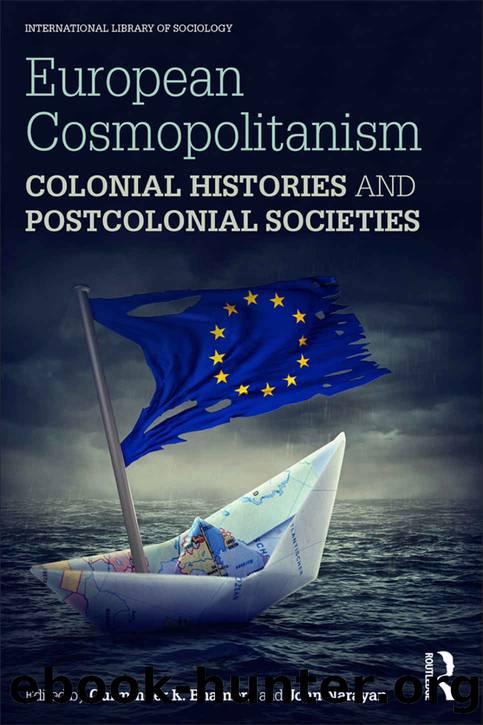
Author:Gurminder K. Bhambra & John Narayan [Bhambra, Gurminder K. & Narayan, John]
Language: eng
Format: epub
Publisher: Taylor and Francis
Published: 2016-10-25T18:30:00+00:00
Past Contradictions and an Uncertain Future
The extent to which the non-European world influenced European developments remains vehemently contested and cannot be dealt with here. Even aspects amenable to quantification such as the material contributions of the Americas have failed to create a consensus. Early claims for the impact of America have been challenged and the role played by European trends emphasised. Whether it is ideas, bullion or foodstuffs, it took a long time for major changes to make a mark and many small changes â for example, the founding of a school or commissioning of a work of art; the leisure made possible by wealth or the boost to technological and scientific developments - are hard to gauge and impossible to generalise from. What is clear is that Europeâs subsequent prosperity cannot be understood without taking into account its interaction with the outside world. The same can be said of intellectual developments: the need to understand the peoples and cultures encountered led to a reassessment of fundamental beliefs of what a human being is, what rights humans have, as well as what civilisation means and why it matters. Such debates laid the foundations for changes that indelibly marked European intellectual, legal and political developments, including a new science of ethnography (Hanke, 1974; Pagden, 1993, etc.). Expansion also had negative repercussions, not least by unleashing the most unsavoury elements of humanity and brutalising the Europeans; by diverting scarce human and financial resources, and increasing the geographical scope of European conflicts. Postulating the interaction between Europe and the non-European world along these lines, however, perpetuates the dichotomy between âEuropeâ and the rest of the world, and introduces an anachronistic division that early-modern states with lands in Europe and beyond did not recognise, as has been demonstrated for the Spanish Monarchy here.
The Monarchyâs marked cosmopolitan tendencies and trajectory provide data of how one large, diverse state composed of many polities functioned successfully. Pluralism and loose association; the devolution and sharing of power; accepting differences in law, customs and much else, and the constant negotiation of reciprocal duties and rights preserved this seemingly unwieldly state for centuries. It was, as Alvarez-Osorio Albariño and GarcÃa GarcÃa (2004) aptly termed it, a âMonarchy of Nationsâ; a multicultural, plural state where individuals had multiple identities, collective and singular (Gil Pujol, 2004; RodrÃguez-Salgado, 1998). It was not diversity but the attempt to homogenise by extending the authority of the monarch and of Castile that almost destroyed it, by undermining the power of local elites and shattering the fiction that each polity existed independently and had equal rights (Thompson, 1995; Gil Pujol 2004 and 2012). Loyalty to a shared sovereign helped to preserve it, and the sheer fact of belonging to a single entity encouraged multiple links. However, it also nurtured competition for resources and attention among the constituent parts which reinforced the sense (and the projection) of difference (Gil Pujol, 2012: 75â6, 79â80, 87â8). And that sense of difference would later merge with nationalist sentiments.
Strengthening nationalist tendencies was an unintended consequence of expansion beyond Europe.
Download
This site does not store any files on its server. We only index and link to content provided by other sites. Please contact the content providers to delete copyright contents if any and email us, we'll remove relevant links or contents immediately.
| Anthropology | Archaeology |
| Philosophy | Politics & Government |
| Social Sciences | Sociology |
| Women's Studies |
Born to Run: by Christopher McDougall(7127)
The Leavers by Lisa Ko(6948)
iGen by Jean M. Twenge(5416)
Sapiens by Yuval Noah Harari(5371)
Spare by Prince Harry The Duke of Sussex(5197)
The Kite Runner by Khaled Hosseini(5179)
Machine Learning at Scale with H2O by Gregory Keys | David Whiting(4313)
Bullshit Jobs by David Graeber(4190)
Never by Ken Follett(3957)
Goodbye Paradise(3810)
Livewired by David Eagleman(3775)
Fairy Tale by Stephen King(3399)
A Dictionary of Sociology by Unknown(3085)
Harry Potter 4 - Harry Potter and The Goblet of Fire by J.K.Rowling(3074)
The Social Psychology of Inequality by Unknown(3031)
The Club by A.L. Brooks(2925)
Will by Will Smith(2920)
0041152001443424520 .pdf by Unknown(2846)
People of the Earth: An Introduction to World Prehistory by Dr. Brian Fagan & Nadia Durrani(2738)
